
Food end-of-line automation: choosing by packaging
A checklist to help food producers choose conveyor, case packing, palletizing and stretch wrapping stations by packaging type, hygiene and capacity needs.
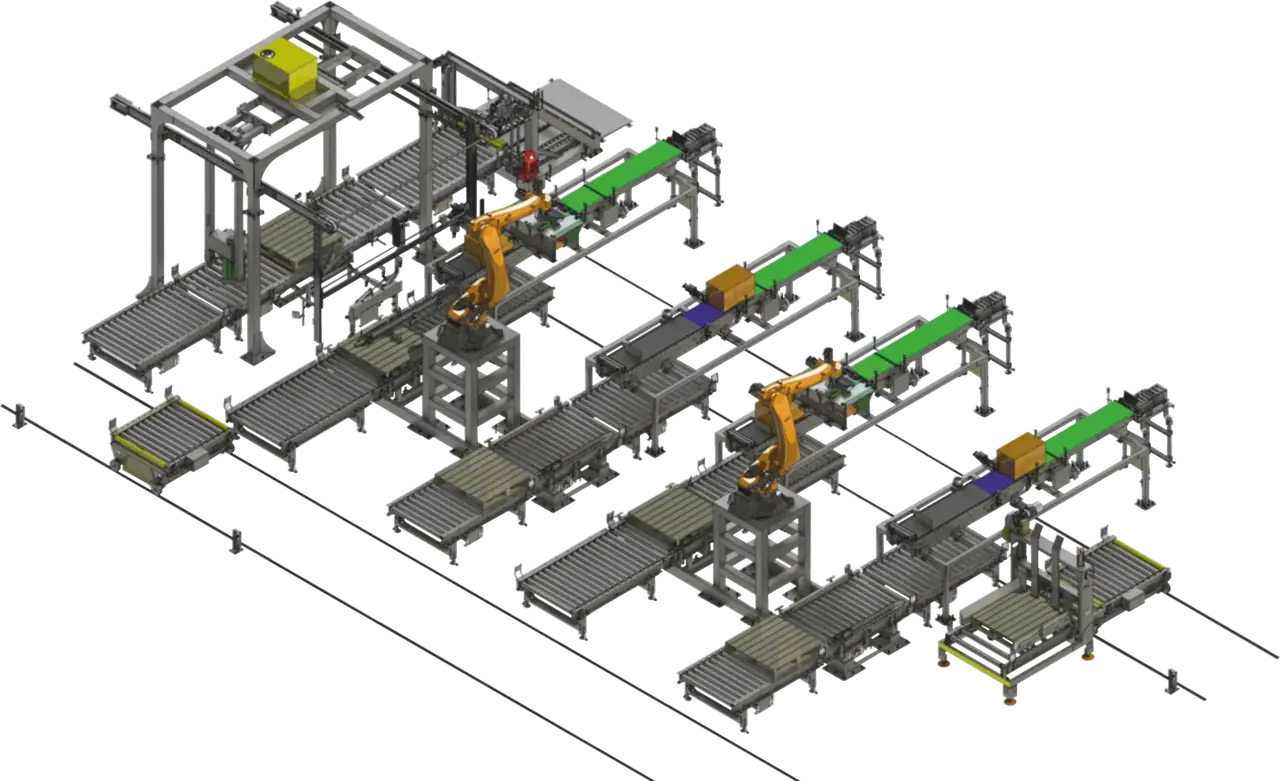
Start with the packaging type
On a food line, the packaging is the first thing that defines the end-of-line equipment. Biscuit and snack cases, flour and pet food bags, yoghurt buckets, cans and jars, pasta packs, and oil tins and bottles each need different conveying and gripping methods.
If more than one packaging type will run on the same line, write this down at the start of the design: product changeover and gripper selection depend on it.
A product-specific gripper for palletizing
- Cased products: clamp gripper
- Cans and tins: magnetic gripper
- Yoghurt buckets: bucket gripper
- Flour and pet food bags: bag gripper
Our robotic palletizing cells use ABB, KUKA, FANUC and Yaskawa robots; the robot and gripper are selected according to product weight and target capacity.
Conveyor belts for hygiene-critical areas
Areas with strict hygiene requirements use acetal and stainless steel (inox) belt conveyors; for conveying packaged products, PVC and modular belts are also an option. Our acetal and inox belt conveyors are designed for 500 – 3,000 kg capacity and 10 – 50 m/min belt speed.
Case packing and case sealing
Case erecting can be vertical or horizontal. Our case sealer tapes 20 cases per minute; case packing speed should be planned together with palletizing and conveyor speeds.
Cold rooms and frozen products
For frozen food and ice cream warehouses, our CSS cold-room stretch wrapper is designed to operate down to –30 °C and in high humidity, wrapping up to 60 pallets per hour. For products where hygiene is critical, the top-sheet option covers the top of the pallet automatically.
Include peak season in the capacity
Seasonal peaks are common in food production. Size the line not only for average output but for the hourly capacity expected in peak periods.
Information for the initial assessment
- Product and packaging dimensions, weight
- Hourly or per-shift capacity target
- Existing line layout and technical drawings, if available
- Target pallet size and pattern
Related pages
- End-of-line automation for the food industry
- Robotic palletizing systems
- Conveyor systems
- Case packing systems
- Stretch wrapping systems
Let’s apply this to your own line.
Share your product, capacity and site details; our engineers will carry out a technical assessment.