
PET bottle palletizing: robot or palletizer?
What to look at when choosing the system that will stack shrink packs, cases or jugs at the end of a PET bottle filling line: packaging type, hourly capacity, pallet pattern, slip sheets and stretch wrapping.
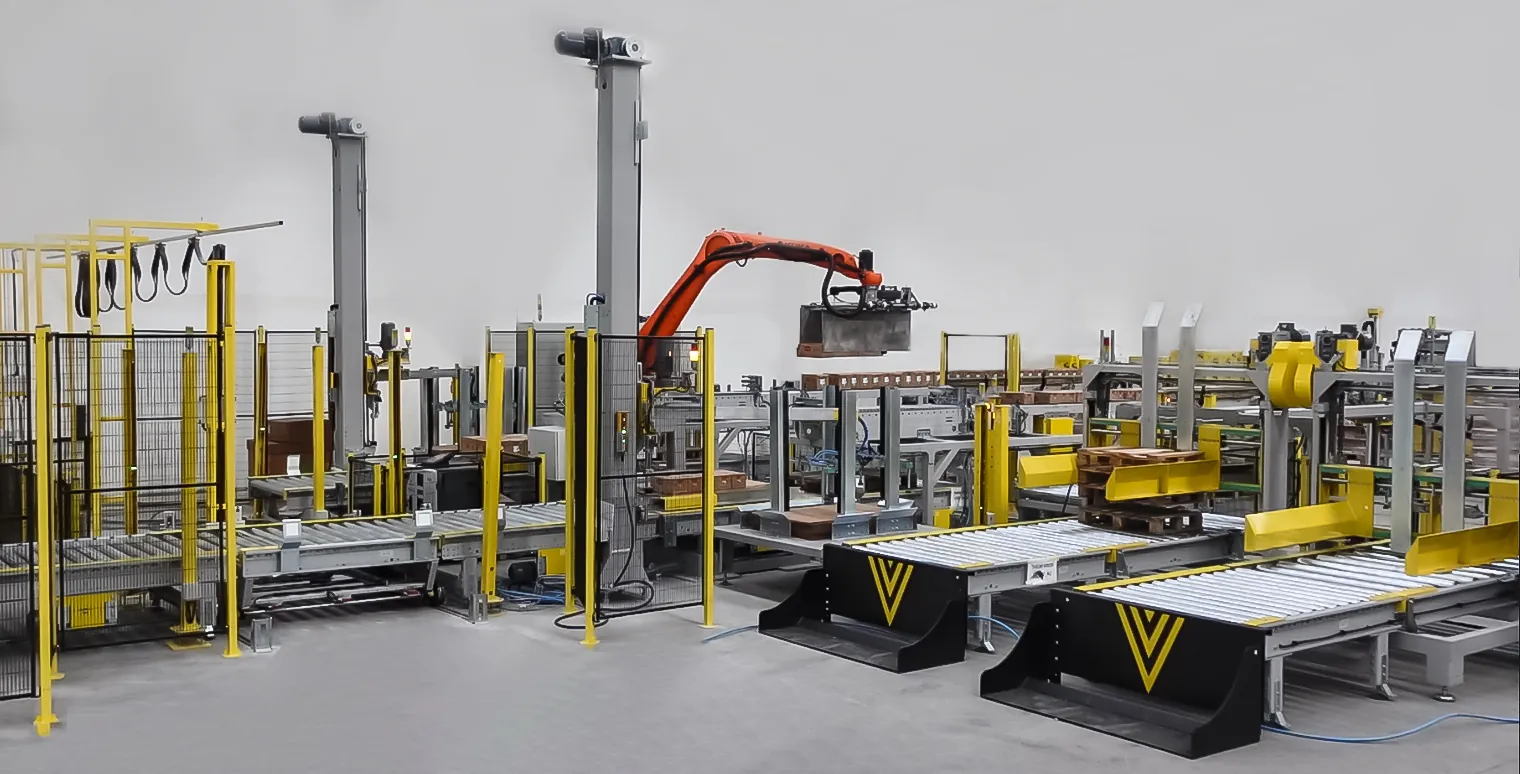
Short answer: which system, and when?
There is no single right machine for PET bottle palletizing; the choice depends on packaging type and hourly capacity. A robotic or hybrid palletizing cell suits shrink packs and cases, an elevator palletizer suits high-volume lines with few product variants, and robotic jug palletizing with a dedicated gripper suits 19 L jugs.
The right system is confirmed by a project analysis based on product dimensions, line speed and pallet pattern. The sections below will help you prepare for that analysis.
Start by defining the packaging
At the outlet of a PET bottle line, products usually arrive grouped rather than one by one. The palletizing system is designed around this final packaging:
- Shrink packs: bottles grouped with film
- Cases: A-box and wraparound cases
- Crated products and single items
- 19 L PET jugs: need a product-specific gripper at the filling line outlet
If more than one packaging type will run on the same line, say so from the start. Hybrid robotic palletizing can handle A-box cases, wraparound cases and shrink-wrapped products in the same cell.
Robotic palletizing cell
In a robotic cell, products reach the robot on a conveyor and the robot stacks them on the pallet layer by layer. When the product changes, the pallet pattern and, if needed, the gripper change; this gives flexibility to beverage lines running different packaging types and pallet patterns.
- PET bottle robotic palletizing runs at 600 – 1,500 packs/h.
- Payload capacity in robotic palletizing is 0 – 1,400 kg.
- We work with ABB, KUKA, FANUC and Yaskawa robots.
- The cell is protected by fencing, a light barrier, a laser scanner and an emergency stop.
Elevator palletizer and Cartesian palletizing
In a palletizer, products are aligned on the conveyor, a layer is formed and the layer is placed on the pallet. It is designed for standard and high-volume production; the elevator palletizer runs at 1,500 – 3,000 packs/h. It stands out on PET bottle lines with few product variants, high line speed and a fixed pallet pattern.
Cartesian palletizing automatically places products that have gone through the sorting and layer forming stages onto the pallet. Aimed at standard production, it runs at 600 – 1,500 packs/h.
Comparison
| PET bottle robotic palletizing | 600 – 1,500 packs/h; different packaging types and pallet patterns |
|---|---|
| Hybrid robotic palletizing | Depends on line speed; cases and shrink packs in the same cell |
| Elevator palletizer | 1,500 – 3,000 packs/h; high volume, few product variants |
| Cartesian palletizing | 600 – 1,500 packs/h; standard production |
| PET jug robotic palletizing | Depends on line speed; 19 L jugs |
Pallet pattern, slip sheets and pallet feeding
PET bottle packs can be palletized with slip sheets between layers. Cardboard, plastic, OSB or plywood slip sheets can be used, and independent pallet and slip sheet feeding systems are available. Fall protection is provided for the elevator and the slip sheet robot.
Pallet sizes of 80×120 cm, 100×120 cm and custom sizes are supported, and layers are built by automatic layer forming. Product size and pallet height determine which pattern gives the most stable pallet. You can try column, interlocked and brick patterns in the simulation on our robotic palletizing page.
A dedicated gripper for jug lines
19 L / 5-gallon water jugs are picked at the filling line outlet by a dedicated gripper with mechanical jaws and a non-slip grip, then stacked in a standard pallet pattern. The system is designed for jugs of 270 – 330 mm diameter and 480 – 560 mm height; other sizes are also supported.
After palletizing: stretch wrapping
Palletized PET bottle loads are wrapped in stretch film before shipping. On the MXSS rotary arm wrapper, the arm turns around the pallet while the pallet stays still, so the load is not shaken; it wraps up to 60 pallets per hour, or up to 50 pallets per hour with a top sheet.
Empty bottle returns: depalletizing
Taking empty bottles off the pallet at the start of the filling line can also be automated. Our bottle depalletizing system transfers glass, metal and plastic bottles from the pallet to the line. Our glass jug, PC rack and PC crate systems can depalletize, palletize, or do both.
How does a project progress?
A PET bottle palletizing project starts with analysis, followed by layout and simulation, mechanical and electrical design, manufacturing and software, FAT and commissioning, and finally training and support. At the simulation stage, the layout and pallet pattern are reviewed together before the line is built.
What to prepare for a quote
- Product and packaging dimensions, weight
- Hourly or per-shift capacity target
- Existing line layout and technical drawings, if available
- Target pallet size and pattern
Frequently Asked Questions
How many packs per hour does a PET bottle palletizing robot handle?
Our PET bottle robotic palletizing model runs at 600 – 1,500 packs/h; for higher volumes, an elevator palletizer reaches 1,500 – 3,000 packs/h. The exact capacity is set by project analysis based on product, pallet pattern and line speed.
Can shrink packs and cases be palletized in the same cell?
Yes. Hybrid robotic palletizing handles A-box cases, wraparound cases and shrink-wrapped products in the same cell; once incoming products are brought into the right format, the robot places them on the pallet layer by layer.
Which pallet sizes do you work with?
80×120 cm and 100×120 cm pallets are standard; custom pallet sizes can also be engineered. Plastic and wooden pallets can be used.
Can the palletizing system be added to an existing filling line?
Yes. We analyse your existing machine outputs, capacity, site dimensions and control infrastructure, then integrate the new stations into the existing line.
Related pages
- Robotic palletizing systems
- End-of-line automation for the beverage industry
- Stretch wrapping systems
- Conveyor systems
- Food end-of-line automation: choosing by packaging
Let’s apply this to your own line.
Share your product, capacity and site details; our engineers will carry out a technical assessment.